PHP2Shell: What the Critical PHP Security Vulnerabilities Mean for Website Owners
Querytech Team
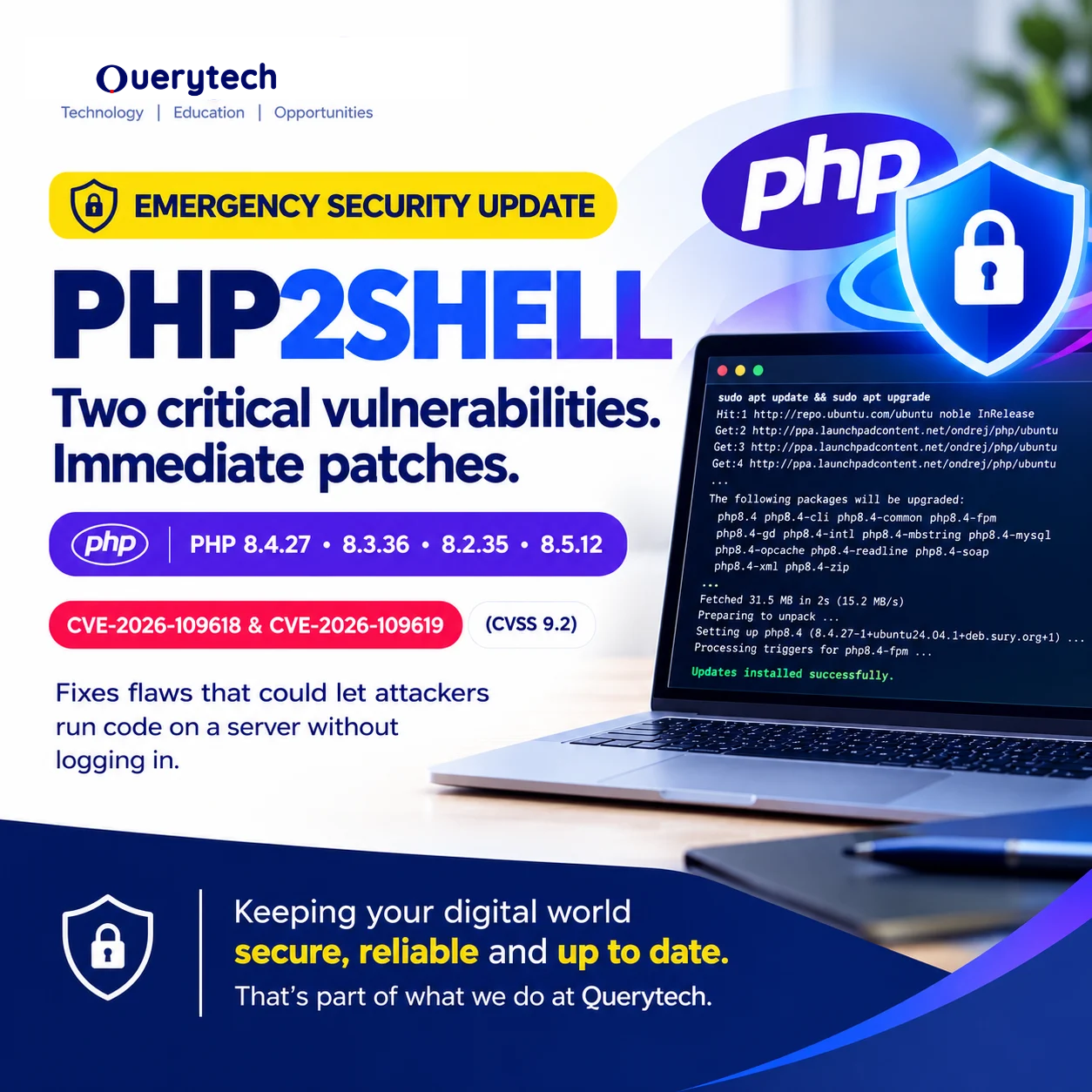
PHP2Shell: What the Critical PHP Security Vulnerabilities Mean for Website Owners
Querytech explains the emergency PHP security patches released on 21 October 2026, why they matter, and what website owners and aspiring developers should do.
Imagine a building with a security door. The door appears to work normally, but someone discovers a weakness that could let an intruder enter without a key.
Now imagine that weakness exists in software used to run websites and web applications.
That is the basic idea behind PHP2Shell, the name associated with two critical security vulnerabilities discovered in PHP.
At Querytech, we believe that understanding technology means understanding not only how to build it, but also how to protect and maintain it.
What is PHP?
PHP is a programming language used to build websites and web applications. It helps websites process requests, communicate with databases, manage information and deliver dynamic content.
Many applications depend on PHP to function correctly.
Think of PHP as part of an application's engine. The application provides the features people interact with, while PHP helps power the work happening behind the scenes.
When a weakness is discovered in PHP itself, the potential consequences can extend beyond a single application.
What is PHP2Shell?
On 21 October 2026, the PHP project released emergency security updates addressing two critical vulnerabilities:
CVE-2026-109618
CVE-2026-109619
Both received a severity rating of 9.2 out of 10 under the CVSS 4.0 scoring system.
The vulnerabilities are serious because they can allow unauthenticated remote code execution.
Let's break that down.
Remote: An attacker can send a request over a network.
Code execution: The server may be tricked into running instructions supplied through that request.
Unauthenticated: The attacker does not need to log in successfully first.
In simple terms, a vulnerable server could be made to carry out unauthorised instructions by someone who has not logged in.
Depending on the server's permissions and configuration, this could put application data, sensitive information and other parts of the system at risk.
The weaknesses are in PHP itself, rather than necessarily being mistakes in an individual website's code. That distinction matters: even an application whose own code is well written may depend on a vulnerable version of PHP.
Which PHP versions received security patches?
The PHP project released the following patched versions on 21 October 2026:
PHP branch | Patched version |
|---|---|
PHP 8.5 | 8.5.12 |
PHP 8.4 | 8.4.27 |
PHP 8.3 | 8.3.36 |
PHP 8.2 | 8.2.35 |
Website owners should update to the appropriate patched version for their PHP branch, or install the corresponding security-fixed packages provided by their operating system or hosting vendor.
Older PHP versions require particular attention. PHP 8.1 and earlier may no longer receive updates directly from the PHP project, although some vendors provide backported security fixes. Website owners should verify their vendor's guidance or arrange an upgrade to a supported version.
Important: Updating an application such as WordPress or Laravel does not automatically mean the PHP runtime underneath it has been patched.
What is Querytech doing about it?
Responsible software development includes monitoring security announcements and responding when important vulnerabilities are discovered.
Following the PHP2Shell security release, we began upgrading PHP components on our server. The work includes the PHP packages and supporting components required by our environment.
But installing an update is only part of the process.
A responsible maintenance exercise should also verify that:
The correct security-fixed packages were installed.
The relevant PHP services were restarted or reloaded where necessary.
The applications still work as expected.
Logs and system behaviour are checked for unexpected errors or suspicious activity.
We take this work seriously because the applications people depend on deserve ongoing attention, not just an initial deployment.
Our upgrade status should be described as complete only after package installation and post-update checks have been verified.
What should website owners and developers do?
If you own a website, manage a server or develop PHP applications, take the following steps:
1. Find out which PHP version is running.
Do not assume that the version installed on your computer is the same version running on your live server. Check the actual production environment.
2. Apply the appropriate security patch immediately.
Follow the PHP project's guidance or your operating system and hosting provider's security instructions. Systems that process public web requests deserve urgent attention.
3. Restart the relevant services if required.
Depending on your environment, this may include PHP-FPM or the web server. Confirm that the running processes are using the patched software.
4. Test the application.
Check important features, database connections, authentication, forms and other critical functions. Review application and server logs for unexpected errors.
5. Investigate possible signs of compromise.
Patching protects against the vulnerabilities going forward, but it does not establish whether someone exploited the server before the update. Review relevant logs and investigate suspicious activity where appropriate.
If you cannot patch immediately, consult the PHP project's official advisory for temporary risk-reduction measures. These measures are not a substitute for installing the security fix.
Official security announcement: PHP2Shell emergency security release.
A lesson for the next generation of developers
There is a valuable lesson here for anyone learning to build software.
Imagine that you have built a school portal. Parents use it to check information about their children, teachers use it to manage records, and administrators rely on it to organise the school.
You have successfully solved a real problem.
Then you discover that a software component powering your portal has a critical security weakness.
What makes you a responsible developer is not simply your ability to write the original code. It is your ability to recognise the risk, understand the dependency, apply the correct fix, test the application and protect the people who depend on it.
That is why professional software development includes maintenance, monitoring, security and continuous learning.
At Querytech Academy, we want our students to develop the ability to solve problems and create opportunities using technology. That also means understanding the responsibility that comes with creating solutions other people trust.
Building an application is the beginning. Keeping it secure and dependable is part of the job.
Technical reference: PHP's official security advisory provides the affected versions, vulnerability details and recommended updates. Consult it for the latest remediation guidance.
Ready to Launch Your High-Income Tech Career?
Don't let lack of direction slow down your growth. Join the next cohort of data leaders and gain hands-on, job-ready skills today.